Silence
Digital Detox as a Team: Three Days Without Notifications
Short answer — Three days without a phone or messaging app can change the way a team communicates, during the stay and sometimes in the weeks that follow. This is not just another team-building exercise: it is a deliberate interruption, with all the resistance and discomfort that entails at the outset. At Casa Lotus Azul, the level of disconnection is decided with you.
What "team digital detox" really means
The expression is often misused. It gets applied to phone-free evenings, offline Fridays, internal policies that are rarely observed. What we are talking about here is different: a three-day immersion during which phones are handed in on arrival and returned on departure. Not left in the bedroom. Not in a bag. Handed in.
For this to work, the rule has to apply to the entire team. It is precisely this shared rule that makes the experience worthwhile for a professional group. When nobody is checking their messages, the informal pressure to reply quickly disappears. This is not an individual decision — it is a collective agreement.
At Casa Lotus Azul, this is the rule on the "Return to Self" retreat: phones are handed in on arrival and returned at the end, and one number remains reachable for family members. For a team, the level of disconnection is decided with you: a complete break for a real detox, or connection maintained for working sessions. Nothing is imposed.
What resists, in the first few hours
The first half-day is almost always uncomfortable. Not because participants did not want to be there — they chose to come — but because habits are stronger than intentions.
Several situations are easy to imagine in a professional group:
- A manager who "just wanted to check one pending email".
- A salesperson who knows a client is due to call back that day.
- A founder who has never been unreachable for more than a few hours in ten years.
These forms of resistance are not whims. They reflect a working culture built on permanent responsiveness. Three days will not fix that culture — but they allow you to see it clearly, which is already a great deal.
The fact that the phone is physically absent, rather than simply switched off in your pocket, makes a difference. The object is no longer there. The impulse has nowhere to go. It passes.
Silence among colleagues: an unusual format
If the group chooses noble silence, as practised on Casa Lotus Azul retreats, participants do not speak to one another, but may address Fabiana, in writing. Meals are taken together, in silence.
For a professional team, this is a complete reversal of the usual codes. In a conventional away-day, most of the value comes from informal exchanges — lunch, the corridor, the evening at the bar. Here, those exchanges do not take place. Or rather: they are deferred.
What happens instead is difficult to anticipate. People observe one another more. They notice things they had not seen before: the way a colleague handles discomfort, the quality of someone's attention during meditation, the way a person who is usually quiet takes up space when words are no longer available.
These observations are not put into words during the silence. They accumulate. They often find expression once people are talking again, with a precision that ordinary meetings rarely allow.
To explore further what silence produces within a group, the article The Benefits of Silence: Three Days Without Speaking develops this point in detail.
What Fabiana has observed over twenty-seven years
Fabiana has been guiding retreats for twenty-seven years, from Guadeloupe to Costa Rica before settling in Portugal. People who come from the working world often arrive with an internalised performance culture.
The first guided meditations are often experienced as a task to be completed. People "do" the meditation as they would attend a meeting. Then, often, something loosens. The absence of a phone, the silence and meals taken without talking eventually produce an effect that no agenda can organise.
For a team, the programme is built with you: the complimentary guided meditation for the group, other guided sessions on request, the place given to silence, the working sessions. On her retreats, Fabiana does not follow a fixed programme: the flow adjusts to the people present.
This flexibility is particularly useful for teams, precisely because every professional group differs in its tensions and in what it needs to work through.
What changes in exchanges, afterwards
After a stay of this kind, what matters most is often not the silence itself, but the conversation that resumes.
What can change, without making any promises:
Meetings may get shorter. Not because people have less to say, but because some become aware of how much noise they usually generate. Silence, paradoxically, creates a desire to speak less and to speak better.
Disagreements may be expressed differently. A few days of coexisting without words impose a form of non-verbal regulation. You learn to let tension pass without immediately putting it into words.
Screens resume their place, but a different one. Nobody comes back from a stay of this kind having resolved their relationship with notifications. But some participants say that they let more time pass before replying, or that they close their tabs during meetings.
These effects are not guaranteed: they are reported tendencies, not measured results. The distinction matters.
The physical setting matters
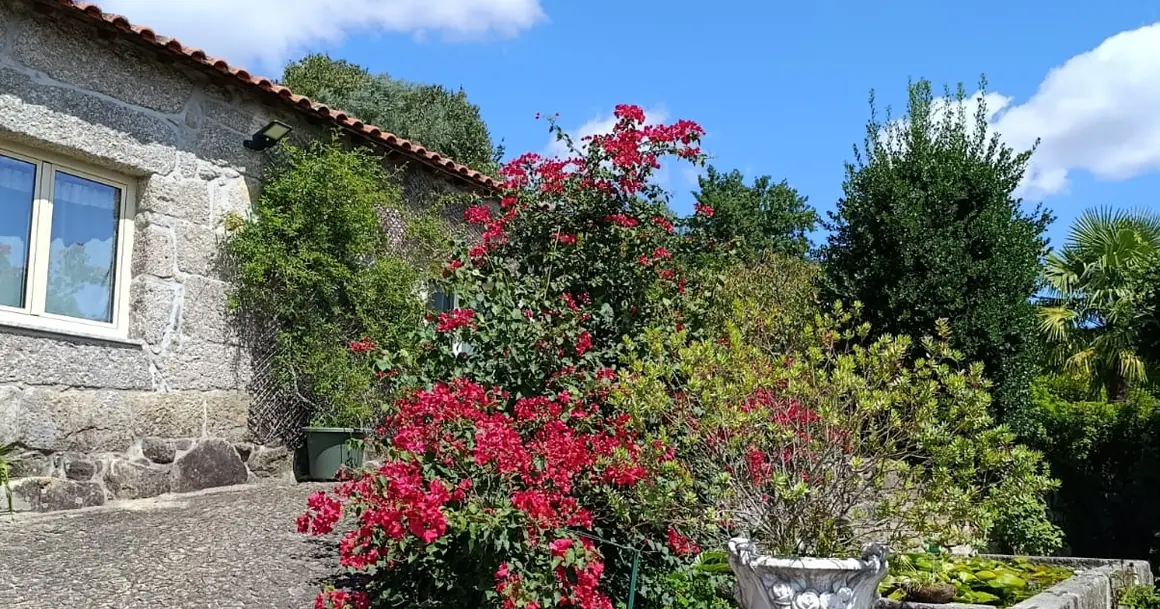
Casa Lotus Azul is in Rendufinho, in the Minho, twenty minutes from Braga, on the edge of the Peneda-Gerês National Park. The venue comprises two granite quintas, Quinta Maria da Paz and Quinta Lotus Azul, with nine bedrooms and a large, light-filled hall opening onto the garden. One hectare of garden, a river below, mountains all around, no neighbours.
For a professional group, this isolation is not a minor detail. The break from the usual working environment is a condition of the experience. A seminar in a suburban hotel, even without phones, does not produce the same effect: the setting is too reminiscent of the ordinary world.
Here, the physical configuration — the granite, the garden, the river, the natural silence of the site — is part of what allows the group to settle. This is not staging. It is a lived-in place, with all the solidity and sobriety that implies.
You can see more on the venue page.
What the stay includes for organisers
The standard format for a group is the organiser package: for eight people, over five days and four nights, the rate is €4,480. This covers the hire of the hall, accommodation, and meals. One complimentary guided meditation is included for the group.
This works out to €560 per participant. Organisers who sell this type of programme on to companies typically charge between €850 and €1,200 per person. The margin covers each facilitator's own communication, organisational, and support costs.
Special terms for the organiser are available on request. A shorter stay, such as three days, can be arranged on request: tell us about your project (dates, number of participants, needs).
| What is included | Detail |
|---|---|
| Accommodation | 4 nights for 8 people |
| Meals | Full board, plant-based, from the kitchen garden |
| Hall | Available throughout the stay |
| Guided meditation | One complimentary session with Fabiana |
| Arrival / departure | 3 pm on the first day, 2 pm on the last |
To compare this rate with the market, the article How Much Do Retreat Venues Charge? The Real Price Grid sets out the usual ranges.
What the format is not
It is useful to name what this stay is not, to avoid misunderstandings.
It is not a cohesion seminar with communication workshops and trust exercises. There is no facilitator running structured speaking sessions, no sticky notes on the walls, no plenary debrief with a PowerPoint presentation.
It is not a therapeutic retreat either. If a team member is going through a recent bereavement, a difficult separation, or a period of psychological fragility, it is advisable to speak to a health professional before booking. The format is not suited to every individual situation, even within a collective setting.
It is not a corporate wellness experience in the usual sense. Discomfort is part of the process. Some people find the first few hours difficult. This is expected, and it is normal.
The article Your First Silent Retreat: 10 Fears, and the Reality can help team members prepare for what they are about to encounter.
Preparing the team before departure
Preparation begins before arrival. An exchange takes place with Fabiana, most often by WhatsApp: this is where the programme, the place given to silence and the level of disconnection are decided.
For a professional group, this preparation phase matters even more. A few points to anticipate:
Inform clients and partners. Three days without a reply is not a catastrophe for most businesses — but it needs to be announced in advance. A well-worded out-of-office reply is sufficient.
Clarify roles during the absence. If the entire team is present, someone else in the company needs to be able to handle genuine emergencies back at the office.
Communicate internally about the format. People in the organisation who are not taking part need to know what this involves — not to have the programme described to them in detail, but to avoid creating unnecessary concern.
A small notebook is recommended for writing down your impressions during the stay. For professional groups, this notebook can become a genuine working tool: ideas noted down in silence, without a meeting or a presentation, that arrive differently from usual.
Why eight people, not twenty
The organiser package is designed for eight participants, like the "Return to Self" retreat. It is not only a question of capacity: it is a choice that changes the nature of the experience.
In a group of twenty or thirty people, collective dynamics take over. Hierarchies reproduce themselves, sub-groups form, and individual attention becomes impossible. In a group of eight, every person is visible — including in the silence.
For a professional team, this format is particularly well suited to executive committees, founding teams, and project teams going through a period of tension or transition. It is less suited to all-staff seminars for large organisations, which require different formats.
The article Small Groups: Why Eight Is Better Than Thirty develops this logic in detail.
Frequently asked questions
Can participants keep their phone for urgent professional reasons? The level of disconnection is decided with you before the stay: nothing is imposed. For a real detox, the simplest option is still a shared rule — phones handed in on arrival, one number reachable for genuine emergencies. It is precisely because the rule is shared that it works for a group.
Can Fabiana run communication workshops in addition to the meditations? Fabiana guides the complimentary meditation for the group; for other guided sessions, ask her. She does not run corporate communication modules: for structured workshops, plan on bringing an external facilitator.
Is the format suitable if the team is going through an internal conflict? It depends on the nature of the conflict. A disagreement about strategic direction may benefit from a pause of this kind. An acute relational crisis between team members requires appropriate support first — mediation or coaching — before considering this format. Speak with Fabiana before booking.
What is the best time of year for this kind of stay? There is no universally ideal moment. A period of transition can be a good time — end of the financial year, the return after the summer holidays, after an intense project phase. The Minho is pleasant in every season; available dates should be checked directly by WhatsApp.
Does the food cater for specific dietary requirements? The cooking is plant-based, from the quinta's kitchen garden; meals can be vegetarian, vegan or gluten-free on request. Let us know about any allergy or intolerance in advance.
Can you visit the venue before booking for a group? A preliminary exchange with Fabiana is planned before every stay; for a visit, ask her.
How does logistics work for a professional group coming from abroad? Casa Lotus Azul is about an hour from Porto airport and twenty minutes from Braga. The easiest way is to come by car; if the group is arriving by plane, train or bus, let us know: we will advise you on the best route and can help arrange a transfer.
Does the €4,480 rate include Fabiana's facilitation? It includes one guided meditation offered to the group. For other sessions with Fabiana, ask her on WhatsApp.
For any questions or to check availability, contact us by WhatsApp on +351 912 823 422. You can also consult the information for organisers directly on the site.
This article is informative and does not replace medical advice. In case of recent bereavement, a painful separation or psychological fragility, please speak to a health professional before booking.
Also worth reading
Filling Your Retreat: What Actually WorksOur “Return to Self” retreat
Three days in noble silence, in a group of no more than eight, in the heart of the Minho. €360 per person, all inclusive.
Message us on WhatsApp