Silence
Organising a Retreat: 7 Mistakes That Cost You Dearly
Short answer — Most costly mistakes made by retreat organisers are not financial at the outset: they are structural. A programme packed too tightly, an absent cancellation threshold, a forgotten insurance policy, and a late arrival time can each derail a retreat that was otherwise well prepared. After twenty-seven years of accompanying retreats, these are the patterns we see most often.
Why this comes from the venue, not a consultant
We do not organise retreats ourselves. We host them. That distinction matters.
From here — a granite quinta in the Minho, twenty minutes from Braga and on the edge of the Peneda-Gerês national park — we observe what happens before, during and after a group arrives. We see the organisers who arrive exhausted because they underestimated their own workload. We see the programmes that collapse by day two because they left no room to breathe. We see the financial consequences of a single no-show when no threshold had been agreed.
This article names seven of those mistakes plainly. It will not tell you what to do in every situation. It will help you avoid the ones we see most often.
If you are still at the stage of choosing a venue, the article Renting a retreat venue: the checklist covers that ground first.
Mistake 1: A programme so dense there is no room for the retreat itself
The most common mistake, and the one with the most immediate consequences.
An organiser arrives with a timetable that allocates every hour: morning yoga, breakfast, workshop, walking session, lunch, rest, afternoon workshop, creative practice, dinner, evening circle. On paper it looks generous. In practice, it leaves participants no time to do what they came for — to slow down.
At Casa Lotus Azul, the structure we use for our own Return to Self retreat includes two guided meditations per day, meals taken in silence, one group activity and one individual guidance session in the afternoon, and extended periods of personal work. That is all. The gaps are not gaps. They are the programme.
When an outside organiser arrives with a denser schedule, we do not prevent them from running it. But we do flag what we have observed: participants who are given no unstructured time tend to leave feeling they attended an event rather than experienced a retreat. The silence does the work. The timetable needs to allow for that.
A practical test: if you removed two sessions from your programme entirely, would anything essential be lost? If the answer is no, remove them before you arrive.
Mistake 2: No cancellation threshold — and no written agreement
This is where financial damage accumulates most quickly.
Six participants is the threshold below which a retreat becomes difficult to balance for an organiser. This is not a figure we invented: it reflects the fixed costs that remain regardless of how many people attend — the venue fee, the food, the travel. If your retreat is priced for eight and three people cancel in the week before arrival, you need either a cancellation policy that covers the shortfall or a financial reserve that absorbs it.
Most organisers who run into trouble here had neither.
A written agreement with your venue should specify: the total fee, the payment schedule, what happens if you cancel as an organiser, and what the venue's obligations are in return. At Casa Lotus Azul, we offer a five-day, four-night package for organisers at 4,480 € for eight people — which works out at 560 € per participant. Organisers typically resell at between 850 and 1,200 €. The margin is real, but it is only protected if the agreement is clear from both sides.
The same logic applies to your participants. Your booking conditions should state clearly what proportion of the fee is refundable and at what point it ceases to be. A participant who cancels three days before arrival and receives a full refund is not malicious — they simply read the terms you provided. If those terms were too generous for your margins, that is a structural problem to solve before registration opens.
See also: Organising a retreat in Portugal: the complete guide for a fuller treatment of contracts and financial planning.
Mistake 3: Forgetting insurance entirely
This one is brief because there is not much nuance to it: if you are organising a retreat as a professional activity, you need civil liability insurance that covers the activities you are running.
We cannot advise you on which policy to take. Your professional association, your accountant, or a broker familiar with wellness events will know the options available in your country of residence.
What we can say is that this is rarely mentioned in the planning phase — and is almost always mentioned after something goes wrong. A participant slips during an outdoor session. A piece of equipment causes an injury. Someone has an adverse reaction during a breathing exercise. These situations are uncommon. They are not impossible.
Check your coverage before you send a single registration confirmation.
Mistake 4: Setting arrival too late in the day
Arrival time has a direct effect on how the first evening unfolds — and how the first full day begins.
At Casa Lotus Azul, we ask groups to arrive at 15:00, before dinner. This leaves enough time for participants to settle into their rooms, walk the grounds, and arrive at the dinner table without feeling rushed. The first meal eaten in silence is also the first real moment of the retreat. If people arrive at 19:30, that moment becomes a scramble.
We have seen organisers set arrival at 18:00 or later, sometimes because they assumed it would be more convenient for participants travelling from a distance. The consequence is that the first evening is compressed, the introduction is shortened, and the first meditation — if there is one — begins with a room full of people who have not yet arrived mentally.
If your participants are travelling internationally or from far away, a late arrival on a pre-retreat day, or a structured early morning start on day one, is a more workable solution than pushing the arrival window back.
Mistake 5: Taking on the host and the participant roles simultaneously
This mistake is more common among first-time organisers, and it is one of the costlier ones in terms of personal wellbeing.
You arrive hoping to experience what you are offering. That is understandable — you built this retreat partly because you needed it yourself. But from the moment the first participant asks a question, you are the host. You are the person who knows where the towels are, what happens if someone has a dietary need that was not flagged in advance, what the plan is if the weather changes and the outdoor session cannot run.
That role and the participant role are not compatible with genuine silence.
There are two practical solutions. The first is to arrive with a clear internal agreement: you are here to hold the space, not to retreat into it. The personal experience can come on a separate occasion. The second is to co-facilitate with someone whose sole role is logistical, freeing you to be more present with the group.
At Casa Lotus Azul, Fabiana remains available throughout — participants can speak to her in writing during the silent period, and she guides the meditations. That support exists for our own Return to Self retreats. For externally organised retreats, we provide the venue, the rooms, and the meals. The facilitation is yours.
For context on what a day at the quinta actually looks like for participants, the article How a day at the quinta unfolds describes the rhythm in detail.
Mistake 6: Not discussing participants' fragility before they arrive
Silence and inward-facing practices can surface things that were not expected. This is not a reason to avoid running retreats. It is a reason to think carefully about who you are inviting and what information you collect beforehand.
A standard pre-retreat intake question should ask whether the participant is currently experiencing a significant loss, a recent separation, or any psychological fragility. This is not about gatekeeping. It is about allowing someone to make an informed choice — and about ensuring that if something surfaces during the retreat, you are not taken entirely by surprise.
We observe this at Casa Lotus Azul: participants in a period of recent grief or acute emotional difficulty sometimes underestimate how much three days of silence will bring to the surface. The experience is not necessarily harmful, but it is more intense than they anticipated. When that has been flagged in advance and the facilitator knows, the response can be measured and appropriate. When it comes as a surprise, it is harder to manage well.
If someone discloses significant psychological fragility during your intake process, the appropriate step is to recommend they speak with a healthcare professional before booking — not to turn them away, but to ensure the decision is made with proper support.
We make this recommendation in our own intake process. We ask organisers to do the same.
Mistake 7: Underestimating the logistical weight of the days before arrival
The retreat begins, for participants, when they walk through the door. For you, it began weeks earlier.
The communications, the dietary requirements, the travel instructions, the pre-retreat document, the registration confirmations, the reminders, the final headcount, the room allocation — each of these is individually small. Together, in the two weeks before a retreat, they represent a significant volume of work. Organisers who have not planned for this tend to arrive depleted.
A simple practice: write down every task that needs to happen between the registration deadline and the arrival day. Estimate how long each takes. Then add thirty per cent, because something will always take longer than expected or need doing twice.
If you are running your first retreat, the article Yoga teachers: your first retreat addresses this preparation workload specifically and honestly.
A note on pricing and margin
Since several of the mistakes above have financial consequences, it is worth being direct about the numbers.
| Format | Casa Lotus Azul fee | Typical resale price | Gross margin per participant |
|---|---|---|---|
| 5 days / 4 nights, 8 participants | 4,480 € total (560 € per person) | 850 – 1,200 € | 290 – 640 € |
| Comparison: market rate for venue alone | 90 – 200 € per person per night | — | — |
The margin is real and workable — provided the retreat fills. A retreat that runs at five participants instead of eight absorbs the same fixed costs across fewer people. At four, most organisers break even at best. Planning your cancellation threshold and your minimum-numbers clause around this arithmetic is not pessimism. It is basic financial hygiene.
For a fuller breakdown of what retreat pricing typically looks like across different formats, the article How much does a silent retreat cost? covers that ground in detail.
What we ask of organisers before they arrive
We have a short conversation with every organiser before confirming a booking — most often by WhatsApp. We ask about the format, the number of participants, the activities planned, and whether there are any particular needs we should know about in advance.
This is not an audit. It is a practical exchange. The more we know before you arrive, the better we can support what you are trying to do.
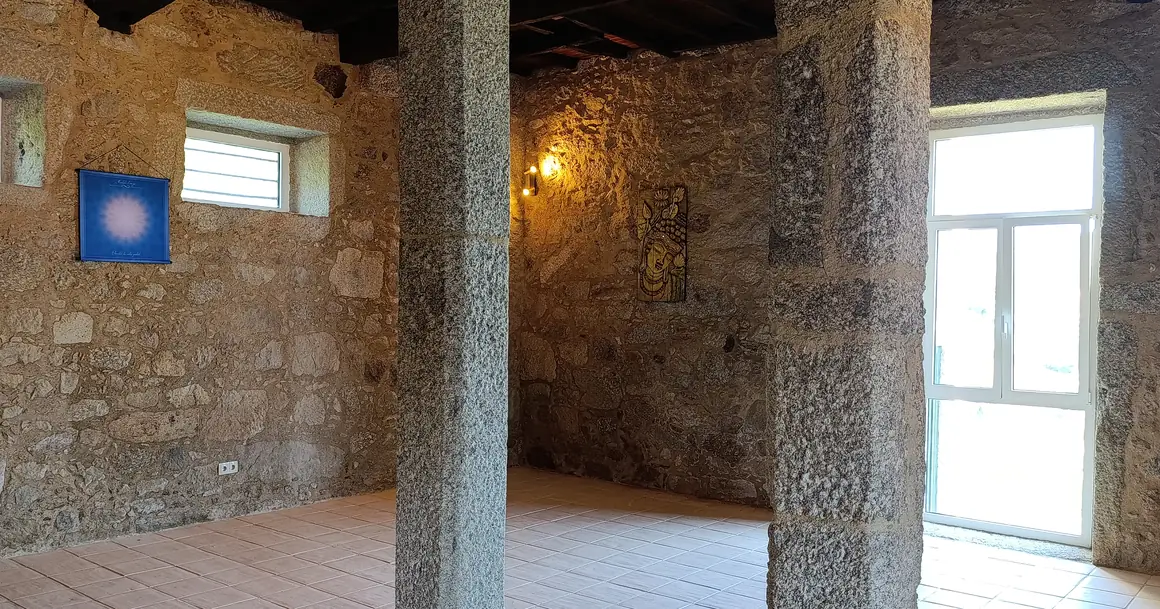
The venue is a one-hectare property in granite, with nine rooms in the Quinta Lotus Azul and a main hall and shared spaces in the Quinta Maria da Paz. There is a river below the grounds, the mountain behind, and no neighbours in sight. Meals are fully plant-based, prepared from the kitchen garden. The space is quiet by nature. What you build inside it is yours to shape.
Frequently asked questions
What is the minimum number of participants for an organisers' retreat at Casa Lotus Azul? Our package for organisers covers up to eight participants. We ask for a minimum of four people for a standard stay outside retreat dates.
Can an organiser request a mediation session for their group? Yes. One guided meditation is included as a gift for groups booking the five-day organisers' package.
Is the venue available for one or two people? No. Stays for one or two people are no longer offered. The minimum is four participants outside of our own structured retreats.
What happens if an organiser needs to cancel? The conditions are discussed and agreed in writing before confirmation. We recommend discussing this explicitly before signing anything.
Can a first-time organiser run a retreat here? Yes, provided the format is clear and the practical conversation has taken place beforehand. The article Yoga teachers: your first retreat is a useful starting point.
Do you recommend that organisers check insurance cover? Yes, always. We cannot advise on the specifics, but we recommend raising the question with a professional before opening registration.
How far in advance should we book? As early as possible. The calendar fills, particularly for spring and autumn dates. Contact us by WhatsApp at +351 912 823 422 to check availability.
If you are at the planning stage and want to talk through the format you have in mind, write to us on WhatsApp at +351 912 823 422. We will answer the practical questions directly and let you know what dates are available.
This article is informative and does not replace medical advice. In case of recent bereavement, a painful separation or psychological fragility, please speak to a health professional before booking.
Also worth reading
Yoga Teachers: Your First RetreatOur “Return to Self” retreat
Three days in noble silence, in a group of no more than eight, in the heart of the Minho. €360 per person, all inclusive.
Message us on WhatsApp