Silence
Corporate Retreat: The Format That Works
Short answer — A corporate retreat works when the duration is long enough to decompress (at least four nights), the group small enough for everyone to be present (eight people at most), and the balance of work and rest thought through from the outset. What teams remember three months later is not the programme. It is the space they were given.
What You Are Looking For, and What You Actually Get
You are organising a corporate retreat because something is no longer quite as it used to be. Not necessarily a crisis. More a deep-seated fatigue, conversations that are growing thinner, a team that keeps turning but without momentum. Or simply the intuition that getting out of the office for two days is no longer enough.
What you are looking for: for people to come back different. Calmer, more available to one another, with ideas that have had time to mature.
What you get if the format is poorly calibrated: a pleasant interlude that everyone talked about in the first week, and that leaves no trace when they return.
The difference comes down to three variables: duration, group size, and the way time is structured. Not the activity, not the venue, not the budget.
Duration: Why Five Days Changes Everything
A one-day seminar serves to convey information or reach a decision. Two days allow people to step out of their usual rhythm. Five days allow something different: time to settle, to let what is normally buried under urgency rise to the surface.
On the first day, participants still arrive in their usual mode. They keep thinking about their messages. They speak quickly. They fill the silence.
On the second day, something shifts. The body has slept somewhere new, meals have been taken at a table without screens, and the internal background noise begins to drop.
It is from the third day onwards that exchanges become something else. Less performative. More direct. People who usually only communicate by email actually see each other.
Five days and four nights is the format we offer to organisers who hire Casa Lotus Azul for their group. Arrival is at 3 pm before dinner, departure at 2 pm after lunch. This structure is not arbitrary: it gives each day a real sense of depth without ever creating a sense of rush.
Group Size: The Threshold Not to Exceed
Eight people. That is the group size the organiser package is designed for.
Why? Because beyond that, the group dynamic changes in nature. In a group of twenty, the quiet people stay quiet. The usual leaders occupy the space as they do in the office. The informal hierarchy reproduces itself.
In a group of eight, every person is visible. Every silence is noticed. Every contribution counts. People cannot fade into the background, and that is precisely what they need.
If your team is larger, the question is not to find a venue that can accommodate forty people. The question is to decide who comes first, or to plan several separate retreats with subgroups. A seminar of forty people is not a retreat. It is an event.
The article Small Groups: Why Eight Is Better Than Thirty goes into this point in detail if you would like to explore the question before deciding.
The Balance of Work and Rest: The Invisible Structure That Holds Everything Together
This is the most common mistake in poorly designed corporate retreats: overfilling. Workshop in the morning, conference in the afternoon, working dinner in the evening. Participants come home more exhausted than before, with the vague feeling of having ticked boxes without having truly thought anything through.
During the "Return to Self" retreat, the day follows a precise rhythm: a guided meditation at daybreak, shared meals in silence, a group activity and guidance in the afternoon, periods of guided personal work, and an evening meditation. For a team hosted on the organiser package, you are the one who builds the programme, but this rhythm offers a good model for alternating work and rest.
This rhythm is not a constraint. It is an architecture. It allows people to move from a state of constant reaction to a state in which a thought can form through to the end.
The unstructured moments — a walk in the garden, time spent sitting by the river — are not wasted time. They are often the moments when something becomes clear. Fabiana has observed this over twenty-seven years: the ideas that emerge during a retreat rarely come during the workshops. They come in the margins.
For a team, this means that a strategic reflection workshop in the morning, followed by an unguided walk and a silent lunch, will often be more productive than a full day of back-to-back workshops.
What Teams Remember Three Months Later
The honest question every manager should ask before booking: what will participants say in three months' time?
Not immediately, not at the end of the last meal when emotions are still running high. Three months later, in the office, on an ordinary Tuesday.
What Fabiana observes on retreat — and she makes no claim that it is measurable or guaranteed — is that what remains is never the content of a workshop. It is a way of speaking to one another. A shared image. The memory of a moment when someone said something true in front of the group, and no one reacted as they usually would.
Those moments happen when the setting is safe enough for people to step out of their role. And the setting becomes safe when there is duration, smallness, and silence.
Silence deserves a particular mention here. It is not a mystical constraint. It is a tool. When people do not talk between activities, they do not replay the same conversations. They do not comment. They let the experience settle. Participants who discover silence on retreat often say that this was precisely what they had not anticipated — and what they appreciated most.
If you are wondering how your colleagues might experience this, the article The Benefits of Silence: Three Days Without Speaking can help you anticipate their questions.
The Question of the Phone
During the "Return to Self" retreat, phones are handed in on arrival and returned at the end; a number remains reachable for family members in the event of a genuine emergency. For a team, the level of disconnection is decided with you: a complete break for a real detox, or connection maintained for your working sessions. Nothing is imposed.
For a corporate team, a complete break sometimes meets with resistance. Someone has an important client. Someone else manages a team that cannot do without them for five days.
If you are aiming for real disconnection, it is best to settle these questions before you leave: who answers on whose behalf, and which emergencies justify a call. A retreat where everyone keeps their phone in hand soon feels like a mere change of location.
The article Digital Detox: 72 Hours Without a Screen addresses the most common forms of resistance and how to prepare your team for them.
The Venue: What the Environment Does Without Being Asked
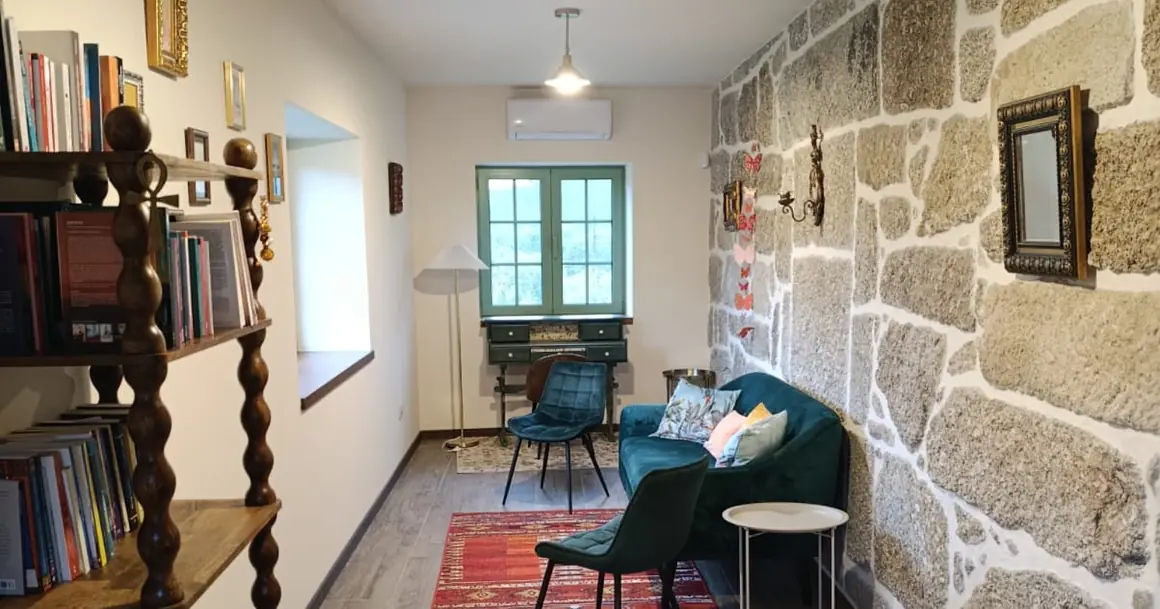
Casa Lotus Azul is in Rendufinho, in the Minho, twenty minutes from Braga. Two granite quintas, nine rooms, one hectare of garden, a river below, mountains all around. No neighbours.
This setting does work that no programme can do in its place. The granite, the silence of the nights, the absence of traffic, the morning light on the garden — all of this acts on people without them realising it. They sleep differently. They eat more slowly. They look outside.
At the gateway to the Peneda-Gerês National Park, the venue is also an invitation to walk, to be in a landscape that has nothing in common with their offices. This sense of being elsewhere is not a luxury. It is a condition: it is hard to change pace in surroundings that remind you of the office.
You can find out more about the venue in the dedicated section of our site.
What Is Included, and at What Price
For organisers who hire the venue for their group, the rate is €4,480 for eight people, five days and four nights. This includes room hire, accommodation, and meals. A complimentary guided meditation is included for the group.
Per participant, this comes to €560. Organisers who offer this format to their teams or their clients typically resell at between €850 and €1,200 per person. Special terms for the organiser exist and can be discussed on request.
Meals are plant-based, from the kitchen garden. The food is not an imposed dietary constraint: it is part of the rhythm of the venue. Meals can be vegetarian, vegan or gluten-free on request.
To compare this rate with market prices and understand what you are really paying for, the article How Much Do Retreat Venues Charge? The Real Price Grid will give you the useful reference points.
What Fabiana Brings to the Group
Fabiana has been guiding retreats for twenty-seven years, from Guadeloupe to Costa Rica, before settling in Portugal. With the organiser package, the group receives a complimentary guided meditation led by Fabiana; for other guided sessions, ask her.
For a corporate retreat, her role is not to run team-building exercises or collective coaching. She guides the complimentary meditation for the group, and the project is shaped with her in advance.
What twenty-seven years of guiding retreats have taught her is that a group generally does not need to be told how to do better together. It needs space and time for what is already there to show itself.
What You Need to Prepare Before You Arrive
An exchange takes place before your stay, most often by WhatsApp. This is not an administrative formality. It is the first step of the work.
It is useful, for the organiser, to reflect on these questions before this exchange: Why now? What do you hope participants will take away? Are there tensions in the group that need to be named? Remember also to let each participant know: in the event of a recent bereavement, a separation or psychological fragility, it is best to speak to a health professional before coming. A retreat is not a therapeutic service, and certain moments in life first require specialist support.
A small notebook is recommended for each participant, to write down feelings, ideas, and whatever surfaces during the periods of silence.
Frequently asked questions
Can periods of collective work be incorporated into the retreat? Yes. You can plan workshops or collective reflection sessions during the day. The room is available. What we recommend is not planning more than one or two per day, and allowing them to breathe with unstructured time before and after.
What if some team members are reluctant about meditation? Meditation is not compulsory: it is offered, not imposed. Sceptical people sometimes end up giving it a try, not because they have changed their minds about the idea, but because the context lends itself to it.
Is the format suited to a team that does not know each other well? Yes, and sometimes more so than a team that has known each other for a long time. The usual relational habits are suspended. People who would never have spoken to each other in any other context find themselves at the same table, in the same silence.
What happens if someone struggles with the silence or the absence of a phone? The level of silence and disconnection is decided with you beforehand: nothing is imposed. On retreat, Fabiana observes that the first few hours are often the hardest, and that most participants find their rhythm fairly quickly. Agree with her, before the stay, who will support the group if difficulties arise.
Can you come with a group of fewer than eight people? The organiser package rate is calculated for eight people. Stays from four people are possible outside retreat dates, from €130 per person per night, full board. We invite you to contact us by WhatsApp to discuss your specific situation.
How do you know whether the format is right for your team before booking? The preliminary WhatsApp exchange is there for exactly that reason. We will ask the relevant questions, we will tell you honestly whether the format matches what you are looking for, and if it does not, we will say so.
Can the article Organising a Retreat: 7 Mistakes That Cost You Dearly help me prepare the process? Yes. It covers the most common mistakes made by organisers, whether they are professionals or organising a retreat for the first time in a corporate context.
To discuss your project, write to us on WhatsApp at +351 912 823 422. The conversation is without commitment, and most questions are resolved in a few messages.
This article is informative and does not replace medical advice. In case of recent bereavement, a painful separation or psychological fragility, please speak to a health professional before booking.
Also worth reading
Filling Your Retreat: What Actually WorksOur “Return to Self” retreat
Three days in noble silence, in a group of no more than eight, in the heart of the Minho. €360 per person, all inclusive.
Message us on WhatsApp