Silence
Meditation Retreat in Portugal: The Formats
Short answer — There are four main formats of meditation retreat in Portugal: Vipassana, guided retreats, monasteries, and yoga centres. Each follows a different logic, appeals to different people, and requires a different level of commitment. Knowing these differences before you book will save you from unpleasant surprises.
What the word "retreat" actually covers
The term is used to describe very different experiences. Three days in a quinta in the Minho with eight people and two guided meditations a day have almost nothing in common with ten days of total silence in a Vipassana centre with a hundred participants. Yet both are called "meditation retreats".
What varies from one format to another: the duration, the structure of the day, the number of participants, the degree of supervision, the relationship to silence, the cost, and the tradition within which the practice sits. Here is an honest look at each of these formats, as they concretely exist in Portugal.
The Vipassana format: what it really is
Vipassana is a meditation technique transmitted in the lineage of S. N. Goenka. The format is standardised worldwide: ten days, total silence between participants, around ten hours of meditation per day, groups of fifty to a hundred and fifty people, funded by voluntary donation only.
In Portugal, there is no permanent Vipassana centre. Courses are organised by a volunteer association at a rented site in the Algarve. The association was founded in 2011; the first course in Portugal dates back to 1990, with nine participants. The nearest permanent centre is in Spain, at Candeleda, in the province of Ávila.
This format suits people who are looking for a lengthy, intensive immersion with little individual guidance, and who are willing to surrender entirely to a rigid framework that is identical for everyone. The absence of fixed fees is a decisive factor for many.
What it offers little of: ongoing individual support, adaptation to each participant's profile, a small-group setting. The format is designed to operate at scale, with the same structure for everyone.
Guided retreats: supervision and group size
A guided retreat is led by one or more people who remain present throughout the stay. The group is generally small. The programme can be adjusted to suit the people present. This is the format that leaves the most room for each participant's individuality.
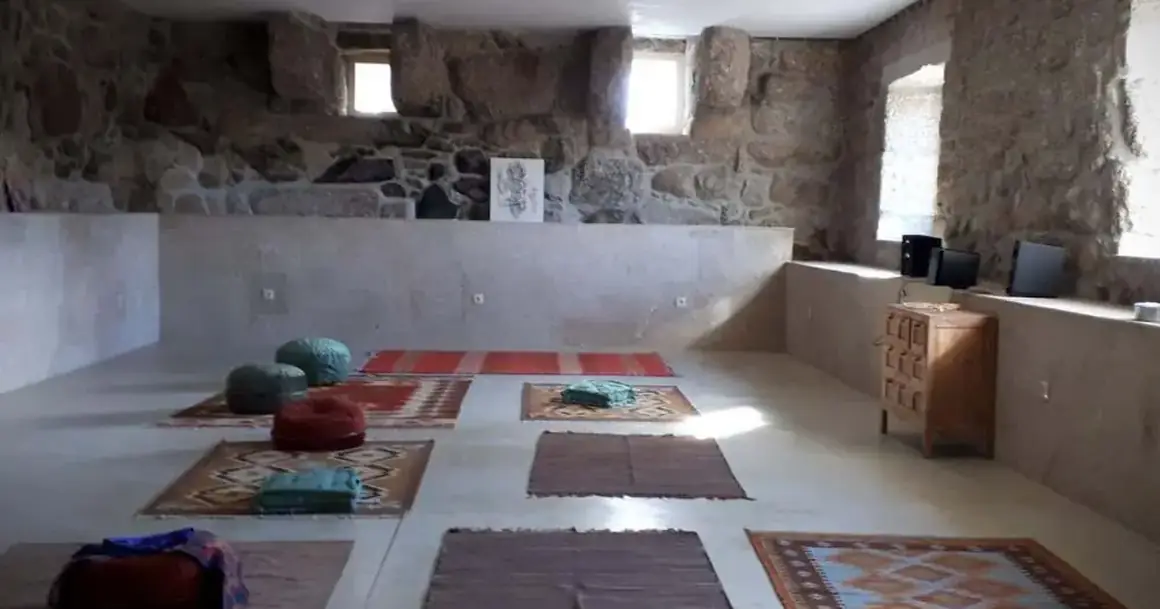
This is the setting for the Return to Self retreat offered at Casa Lotus Azul: three days, two nights, a maximum of eight participants, two guided meditations per day, meals taken in silence, plant-based full board from the kitchen garden. Fabiana has been guiding retreats for twenty-seven years, from Guadeloupe to Costa Rica before Portugal. She remains reachable during the silence, in writing.
What this format allows that Vipassana does not: an exchange before arrival, a check-in on each person's motivations upon arrival, an adjustment of the programme according to the group, and direct human presence if something arises during the stay.
What this format does not replace: the depth of a ten-day practice, if that is what you are looking for. Three days is an introduction, not a long-term immersion.
For those who have never done a silent retreat, the article Your First Silent Retreat: 10 Fears, and the Reality can help you untangle what is simply normal apprehension from what deserves closer attention.
Monasteries: a tradition that predates the wellness retreat
Several monasteries in Portugal welcome people wishing to spend a few days in a monastic setting. This is a different kind of undertaking: the silence there is rooted in religious tradition, not in a personal development programme.
The setting is often austere, the schedule is governed by the canonical hours, and participation in communal times is expected or obligatory depending on the house. This is not a suitable place for someone primarily seeking a secular meditation practice.
This format may suit people with a religious spiritual sensibility, or those who wish to withdraw from the world in a setting that bears no resemblance to a wellness product. It generally does not offer guided meditation in the contemporary sense.
Yoga centres: yoga and meditation — in what order?
Yoga centres frequently offer retreats combining yoga, pranayama, and meditation. Portugal has several, particularly in the Alentejo and the Algarve. The format is generally more flexible than Vipassana, less strict about silence, and oriented towards physical practice as much as contemplative practice.
This type of retreat suits people whose entry point is the body: they come to move, to stretch, and then to sit. Meditation there is often complementary to yoga, rather than central to it.
This is not the setting of Casa Lotus Azul, where meditation is the heart of the stay. If you are a yoga teacher and wish to offer a retreat to your students at a dedicated venue, the article Yoga Teachers: Your First Retreat sets out in concrete terms what that involves.
Comparative table of the four formats
| Format | Typical duration | Group | Silence | Individual support | Indicative cost |
|---|---|---|---|---|---|
| Vipassana | 10 days | 50 to 150 people | Total | Limited | Voluntary donation |
| Guided retreat | 3 days to a week | Small group | Noble silence | Yes | €300 to €500 (3 days), €700 to €1,200 (one week) |
| Monastery | Variable | Variable | Monastic silence | Variable | Variable |
| Yoga centre | Variable | Variable | Partial | Depends on the venue | €800 to €1,500 |
Silence is not the same across formats
This is something many people do not realise until they arrive. "Silence" can mean very different things depending on the setting.
In a Vipassana, silence is total between participants, and you speak to the team only when you need to. In a monastery, silence is shaped by the liturgical rhythm: one speaks at certain times, not at others. In a yoga centre, silence may only be required at night or during meditations.
At Casa Lotus Azul, the chosen format is noble silence: participants do not speak to one another, but may address Fabiana, in writing. Meals are taken together, in silence. Phones are handed in on arrival and returned at the end of the stay; a number remains available for loved ones to reach. This framework allows a genuine break without total isolation.
If the question of silence concerns you, the article The Benefits of Silence: Three Days Without Speaking explores what this kind of experience produces, without therapeutic promises.
What group size changes in practice
In a group of a hundred people, you can go through ten days without anyone noticing you are struggling. In a group of eight, that is impossible to conceal — and this is not a problem; it is often precisely what people are looking for.
Group size changes the quality of presence the guide can offer. With eight participants, Fabiana can observe what is happening for each person, adjust the pace of the afternoon, and offer different personal work depending on the individual. With fifty or a hundred participants, this kind of adjustment is simply not possible, regardless of the quality of the teacher.
This is one of the points developed in the article Small Groups: Why Eight Is Better Than Thirty, if you wish to explore this further.
The question of cost
Vipassana is funded by voluntary donation, which makes it accessible to people without financial means. This is a strong ethical position, and it is consistent with the tradition within which this format sits.
Guided retreats are paid for. This is a different model: a venue, a team, a kitchen, and personalised support all have a real cost. The Return to Self retreat is €360 per person, all inclusive — accommodation, plant-based full board, two guided meditations per day, and time for personal work. Individual bookings are accepted.
To place this price in context: guided three-day retreats generally fall between €300 and €500. A week-long guided retreat generally falls between €700 and €1,200, and a stay at a yoga centre between €800 and €1,500. The article How Much Does a Silent Retreat Cost? sets out these ranges in detail.
What the venue brings, independently of the format
The setting in which a retreat takes place is not neutral. Casa Lotus Azul comprises two granite quintas in Rendufinho, Póvoa de Lanhoso, in the Minho, twenty minutes from Braga and on the doorstep of the Peneda-Gerês National Park. One hectare of garden, a river below, the mountain all around, no neighbours.
This kind of environment — quiet, secluded, in contact with nature — is not offered by the majority of urban or semi-urban centres. Quinta Lotus Azul houses the nine rooms.
This is not a sales pitch. It is simply a reality: outer silence makes inner silence easier, and a place with no traffic noise and no neighbours is part of that.
This format is not for everyone
No format suits everyone, and it is better to say so clearly.
If you are going through a recent bereavement, a difficult separation, or a period of marked psychological fragility, it is advisable to speak to a healthcare professional before booking, whatever format you choose. Silence and the suspension of ordinary noise can bring to the surface things that everyday activity keeps at bay. This is not inherently dangerous, but it is not trivial either, and certain moments call for a different kind of support.
How to choose
A few simple questions can help guide your choice:
Are you looking for a long, intensive practice without individual support? Vipassana is designed for that.
Are you looking for a first encounter with silence, in a human, supported setting? A three-day guided retreat is a fitting starting point.
Do you have a religious sensibility and are you looking for a traditional spiritual framework? A monastery may suit you.
Does your practice begin with the body? A yoga centre will probably offer the right balance.
There is no format that is superior to the others. There are formats that correspond — or do not correspond — to what you are looking for at the moment you are looking for it.
Frequently asked questions
Is Vipassana accessible to a beginner? Yes, the format is open to beginners. However, ten hours of meditation a day for ten days represents a significant physical and mental commitment. Some people find it helpful to begin with a shorter retreat to see how they respond to the practice and to silence before committing to ten days.
Can you do a retreat alone, without a group? Some venues offer individual stays. At Casa Lotus Azul, stays for one or two people are no longer offered. The minimum is four people for a stay outside retreat dates, from €130 per person per night, full board.
Are there meditation retreats in Portugal outside the Algarve? Vipassana courses are held in the Algarve, at a rented site. Other formats — guided retreats, yoga centres, quinta stays — exist in other regions, including the Minho. Casa Lotus Azul is located in Rendufinho, twenty minutes from Braga.
Does the silence begin on arrival? At Casa Lotus Azul, there is an exchange on arrival about each participant's motivations; the silence then begins. Phones are handed in on arrival.
Can you write during the stay? Yes. A small notebook is recommended for jotting down impressions as the days pass. Over twenty-seven years of guiding retreats, Fabiana has seen it prove useful; it is never compulsory.
How can you find out about upcoming dates? The dates for Return to Self retreats and the monthly meditations open to all are shared via WhatsApp. You can contact Casa Lotus Azul at +351 912 823 422.
Is this format suitable if I am going through a difficult period? If you are going through a recent bereavement, a separation, or significant psychological fragility, it is advisable to speak to a healthcare professional before booking. This advice applies to all retreat formats.
To ask a question or find out about upcoming availability, write to Casa Lotus Azul on WhatsApp at +351 912 823 422.
This article is informative and does not replace medical advice. In case of recent bereavement, a painful separation or psychological fragility, please speak to a health professional before booking.
Also worth reading
Filling Your Retreat: What Actually WorksOur “Return to Self” retreat
Three days in noble silence, in a group of no more than eight, in the heart of the Minho. €360 per person, all inclusive.
Message us on WhatsApp