Silence
Burnout: Is Silence a Good Idea?
Short answer — Silence can offer a welcome space for rest after burnout, but it is not a substitute for medical or psychological care. Before booking anything, speak to your doctor or a mental health professional.
What Burnout Does to the Body and Mind
Burnout is not simple tiredness. It is a state of profound exhaustion — physical, emotional, cognitive — that builds gradually and takes time to lift. When it is truly present, the body struggles to recover even after a full night's sleep. Thoughts go round in circles. Even the smallest decision comes at a cost.
This context matters. Because a silent retreat, however gentle its setting, is an inner experience. And an inner experience, for someone whose resources are very low, can prove more difficult than expected.
That is not a reason to never consider silence. But it is a reason not to pursue it at just any moment, or in just any way.
Rest and Treatment: Two Different Things
The first question to ask yourself is simple: are you looking for rest or treatment?
Rest means stepping away from noise, schedules, screens, and demands. It means sleeping, eating prepared meals, walking without a destination. Many people coming out of burnout need this above all else.
Treatment is something else. It is structured support — medical, psychological, therapeutic — that seeks to address or stabilise something. Meditation, silence, and energy-based treatments are not treatments in the medical sense. They are practices that can support wellbeing, but they do not treat burnout, depression, or any medical condition.
Confusing the two can lead to disappointment, or even to a worsening of your state if the retreat draws on resources you simply do not have.
Why Silence Can Appeal When You Are Exhausted
The idea is intuitive: no more noise, no more phone, no more meetings, no more notifications. For someone who has been running on empty for months, the image of a quiet garden and three days without speaking can seem almost like paradise.
And there is something right about that. Leaving your usual environment — with its stress triggers, its constraints, its mental load — allows you to begin to decompress. Nature, prepared meals, having nothing to organise: all of this can already bring relief.
What Fabiana has observed over twenty-seven years of guiding retreats is that the people who benefit most are often those who arrive with a minimum of inner stability — not necessarily serene, but capable of moving through whatever surfaces without being overwhelmed by it.
What Silence Can Bring to the Surface
This is the point rarely mentioned in brochures: silence brings things to the surface.
When external noise falls away, internal noise takes up more space. Emotions that had been set aside — sadness, anger, shame, fear — can appear unexpectedly. Memories return. Obsessive thoughts settle in. This is not an anomaly: it is precisely what silence allows.
But if you are already very fragile, this movement can become destabilising. In a study published in Clinical Psychological Science in 2021 (Britton, Lindahl, Cooper, Canby, Palitsky), 83% of participants in an eight-week mindfulness programme reported at least one side effect, 58% reported an effect experienced negatively, and 37% reported an effect that had an impact on their daily functioning. A 2021 international study (Goldberg) found that 22% of regular meditators reported unpleasant experiences and 13% reported experiences classified as adverse, with higher rates among people with a psychological history. These studies concern meditation programmes, not a three-day retreat: they give an order of magnitude, not a measure applicable to what we offer.
This is why a guided retreat is preferable to a solo retreat for someone coming out of burnout. Here, Fabiana remains present and available throughout the entire stay. She does not intervene in place of a therapist, but she is there if something intense surfaces.
The Question to Ask Your Doctor Before Booking
Before signing up for a silent retreat, speak to your doctor or psychologist, if you have one. The question is not "do I want to go?" — you probably do — but "do I have the resources to move through three days of silence right now?"
If you are on sick leave, on medication, if your sleep is still very disrupted, if you are going through a period of great emotional fragility, it is wise to seek professional advice first. Not because the retreat is inherently dangerous, but because timing matters.
If you have recently experienced bereavement, a difficult separation, or a traumatic event, the same recommendation applies. This is not a definitive contraindication, but a precaution worth careful thought.
What We Offer, and What We Do Not Promise
The "Return to Self" retreat lasts three days and two nights. It includes accommodation, full board, plant-based, from the kitchen garden, two guided meditations per day, and periods of silence between participants — what is known as noble silence. Your phone is handed in on arrival and returned on departure. One number remains reachable for loved ones.
This is not a burnout treatment programme. It is not therapy. It is a structured, calm, guided space in which some people find something that resembles the beginning of deep rest. Others move through difficult moments. Others leave without having experienced what they had hoped for.
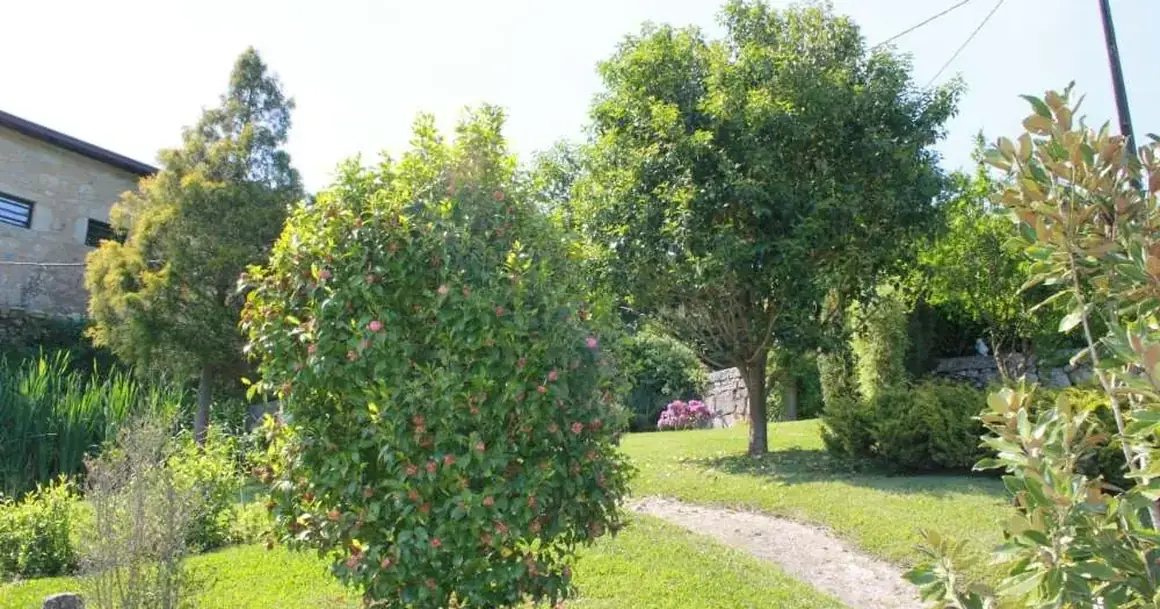
We do not promise transformation. We do not promise healing. We offer a setting: a one-hectare garden, a small river, the mountains all around, meals prepared with vegetables from the kitchen garden, and a caring presence.
What you find there depends on what you bring with you — and on what you are able to move through at the time you come.
A Physical Setting That Helps
The venue itself is worth describing, because the setting contributes to rest.
Casa Lotus Azul is located in Rendufinho, in the Minho, twenty minutes from Braga and on the doorstep of the Peneda-Gerês national park — the only national park in Portugal. A one-hectare organic garden, crossed by a small river. More than four hundred trees planted one by one along winding paths. No neighbours. The mountains all around.
The nine bedrooms are in a fully renovated stone building, with a large, light-filled room of 140 m² whose full-length windows open onto the garden. The kitchen is vegetarian, vegan, or gluten-free on request, predominantly organic, prepared with vegetables and fruit from the kitchen garden and fruit trees.
For someone who is exhausted, having nothing to decide — not what to eat, not where to go, not who to call — is already a form of relief. The kitchen and meals are designed with this in mind.
Guided Silence, Not Solitary Silence
There are several ways to encounter silence. Staying at home without a phone. Going into the mountains alone. Joining a long stay in an intensive format. Or coming to a guided venue, with a light framework and an available presence.
For someone coming out of burnout, the guided format is generally the most suitable. You can read our article on Guided Silent Retreat: Don't Start on Your Own to understand what that changes in practice.
Three days is also a duration that allows you to enter silence without it becoming an ordeal. It is long enough to decompress, short enough not to find yourself alone with emotions that have nowhere to go. For those considering their first experience, the article on Your First Silent Retreat: 10 Fears, and the Reality addresses the most common concerns with honesty.
Before You Come: The Preliminary Conversation
We are not in a position to assess your state of health. But we encourage an honest exchange before booking.
This exchange most often takes place via WhatsApp. It gives you the opportunity to say where you are, what you are looking for, and what you need. If Fabiana senses that the timing or the format does not match your situation, she will say so.
This is not a selection process. It is a way of making sure you come at the right moment, in the right setting, with realistic expectations.
What the Stay Does Not Replace
A few direct words, because this matters.
Silence does not replace psychological support. Meditations do not replace medical treatment. The garden and the river do not replace a therapist.
If your burnout is recent and severe, the priority is medical care. Not a retreat. The retreat can come later, as a complement, as a space to breathe within a care journey — not as a sole solution.
If you have not yet consulted a professional, start there. If you are already receiving support and your health professional considers that a break in this kind of setting could be beneficial, then the conversation is worth having.
What the Research Says (and Its Limits)
A meta-analysis published in the Journal of Psychosomatic Research in 2017 (Khoury et al.) analysed 21 studies involving 2,912 participants practising mindfulness. It observed a moderate effect (Hedges' g 0.45 pre–post, 0.49 versus controls). The authors themselves highlight the lack of methodological rigour in many of the included studies. This is not a validation; it is a pointer.
We do not cite this research to justify anything. We cite it to say that reality is nuanced: silence and meditation can help some people in some circumstances, and be counterproductive in others.
After a retreat, it can take several days before what has shifted becomes visible. Our article on After the Retreat: Integrating What Has Shifted offers some markers for moving through that period.
Frequently asked questions
Is burnout a contraindication to a silent retreat? Not necessarily, but timing and your level of stability matter. Recent, severe burnout requires medical care first. Speak to your doctor before booking.
Can you speak to Fabiana during the retreat if something surfaces? Yes. Noble silence applies between participants. You can approach Fabiana, including in writing. She remains present and available throughout the entire stay.
Do you have to hand in your phone if you are on sick leave and your doctor may need to reach you? This is a question to raise during the preliminary conversation. One number remains reachable for loved ones. The precise arrangements are agreed together before you arrive.
Is the "Return to Self" retreat suitable for beginners in meditation? Yes. No prior experience is required. The meditations are guided by Fabiana. But if you are in a state of significant psychological fragility, speak to a health professional first.
Are individual treatments available as an add-on? Yes, individual treatments with Fabiana of approximately 1 hour 30 minutes are possible. Options such as lymphatic drainage or a cacao ceremony can also be considered. These practices are not medical treatments.
How much does the "Return to Self" retreat cost? €360 per person, all inclusive: accommodation, full board, plant-based, from the kitchen garden, and meditations over three days and two nights. Only transport is not included. For a comparison of prices, our article How Much Does a Silent Retreat Cost? provides an honest reference guide.
How do you know if now is the right time to come? Contact us via WhatsApp at +351 912 823 422 before booking. A simple conversation often answers that question — and if the timing is not right, we will say so.
If you are wondering what three days of silence could offer you at this point in your life, the first step is an honest conversation — with your doctor, and then with us if that feels right. You can write to us via WhatsApp: we respond, and we will not sell you anything if the format does not suit your situation.
This article is informative and does not replace medical advice. In case of recent bereavement, a painful separation or psychological fragility, please speak to a health professional before booking.
Also worth reading
Corporate Retreat: The Format That WorksOur “Return to Self” retreat
Three days in noble silence, in a group of no more than eight, in the heart of the Minho. €360 per person, all inclusive.
Message us on WhatsApp